The Cathedral of Porto
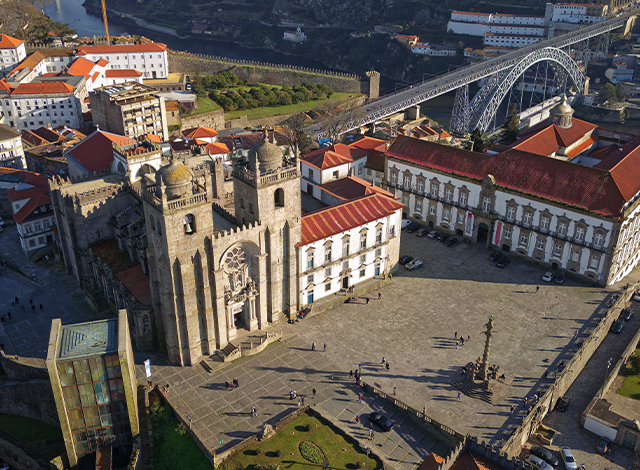
Rising on the hill of Pena Ventosa, the Porto Cathedral has a visual and symbolic presence and has been a defining element of the landscape throughout the city's history. Its construction reflects the social, economic and cultural development of the city, evident in the various layers of heritage value that the building carries, which have affected urbanism, architecture and the arts in general. Of Romanesque origin, it brings together artistic structures from the Gothic, Renaissance, Mannerist, Baroque and Neoclassical periods. The image we see today, however, is the result of a reinterpretation of 20th century restorations. The cathedral is a living reality in constant transformation, vulnerable to the tastes of all those who pass through it, motivated by devotional, institutional, professional, cultural and tourist reasons.
The architectural complex consists of the church with a Latin cross plan, with the 18th century Baroque galilee standing out to the north. The Chapter House extends to the south and includes the Gothic chapel of Saint John the Evangelist. The Gothic cloister rises in the centre and is surrounded to the west by the Chapter House, to the south by the chapel of Saint Vincent, the Nasoni staircase and the Chapel of Our Lady of Piety and to the east by the sacristy.
The parvis and urban layout that currently surrounds it are the result of an intervention in the 1930s. The dense medieval houses, marked by narrow, winding streets, disappeared to free up the ‘monument’, which was subject to the new heritage values of the last century. To the south stands the Episcopal Palace, built in the second half of the 18th century by Bishop João Rafael de Mendonça (1717-1793).
The Cathedral Façade
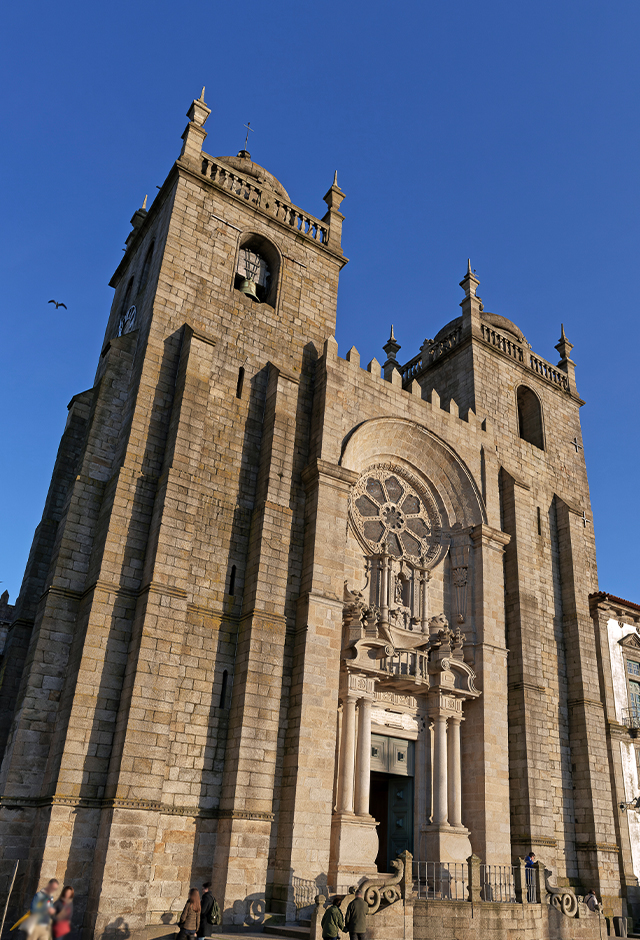
The cathedral façade is bordered by two bell towers of medieval heritage. The balconies, pyramids at the corners and bulbous domes at the ends, however, date from the 18th century. The creation of the large rose window, in Gothic style, is ascribed to the master Domingos Peres and dates to the last quarter of the 13th century. The medieval portal disappeared with the work carried out between 1729 and 1730. What we see today is a Baroque work adulterated by restorations in the 1930s. The semicircular balcony and the niche with the image of Our Lady of the Assumption, the cathedral's patron saint, date from the Baroque period, but all the other sculptures from that period were removed in the last century.