The Gothic Cloister
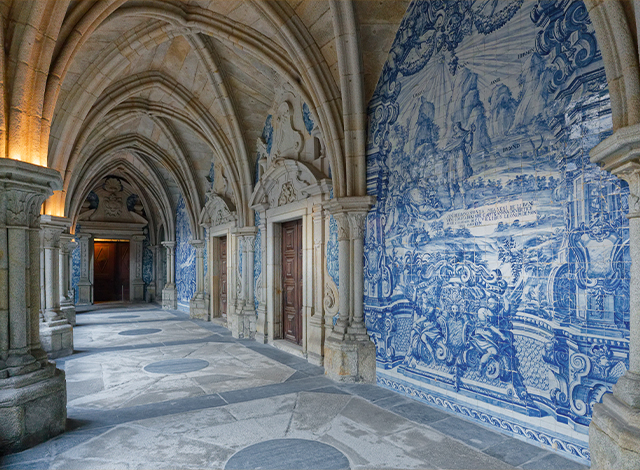
The cloister is the cohesive space of the cathedral's organic life, the unifier of all its constituent elements, a place of circulation and light, but also of knowledge, meditation, prayer and memory.
This cloister began to be built in 1385. The Porto City Council offered 1,000 carved stones in support of Bishop João III (1373-1389) in the cause of King João, Master of Avis (King João I, founder of the Second Dynasty), during the Dynastic Crisis of 1383-1385. The work brings together a group of around 200 columns that give the whole a good rhythm, despite the architectural errors visible in some of the arches.
The space was remodelled in the 18th century. The mouldings and trims of the doors of the four chapels were installed in 1727.
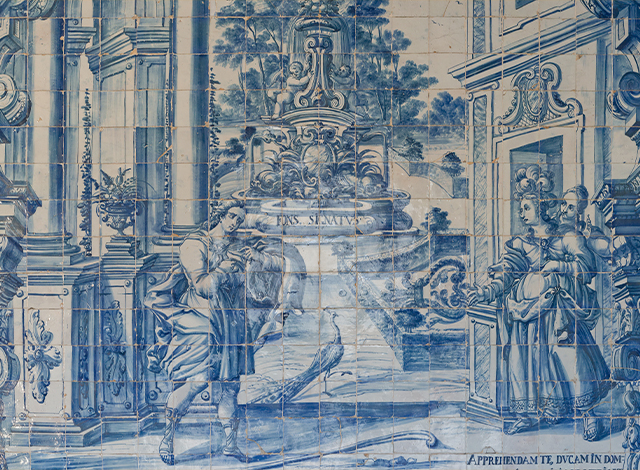
The tiles date from 1729-1730. The tiles were made in Lisbon, in the Mocambo neighbourhood (now the Madragoa and Lapa neighbourhoods) and designed by master painter Valentim de Almeida. The panels depict themes inspired by the Song of Songs, an Old Testament book ascribed to King Solomon. Structured based on a passionate dialogue between a couple, the text symbolises, in this context, the union of Christ (the husband) with His Church (the perfect wife). The message also refers to the Immaculate Woman, Virgin and Mother, invoked in the four chapels of the cloister.
Chapel of Our Lady of the Conception
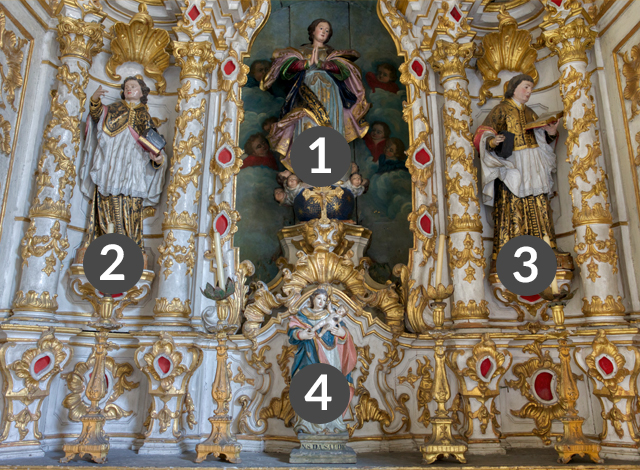
1 - Our Lady of the Conception, the ‘all pure one’, who was conceived and conceived without sin.
2 - Saint Vital of Ravenna (1st century). Roman soldier martyred in the city of Ravenna (Italy), invoked against headaches because he was buried alive, upside down.
3 - Saint Felix. The martyr wears liturgical vestments and holds a book in his hand, symbolising his persistence in faith in Christ.
4 - Our Lady of Health, represented as a Virgin of Tenderness, a mother cradling her child in her arms.
Chapel of Our Lady of Expectation
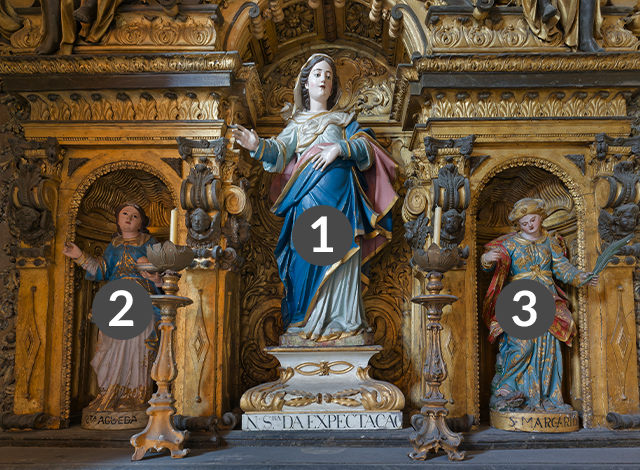
1 - The image represents the pregnant Virgin Mary, whose feast day is on 18 December. For this reason, she is the protector of pregnant and parturient women.
2 - Saint Agatha (3rd century) - Virgin martyr whose breasts were ripped out and then healed by Saint Peter. Protector of nursing mothers, wet nurses and all breast-related illnesses.
3 - Saint Margaret of Antioch (3rd century) - Virgin martyr who triumphed over the devil on the Cross. She is also the patron saint of pregnant women.
The three images guarantee the protection of the three fundamental stages of motherhood: pregnancy, childbirth and breastfeeding.
Chapel of The Nursing Madonna
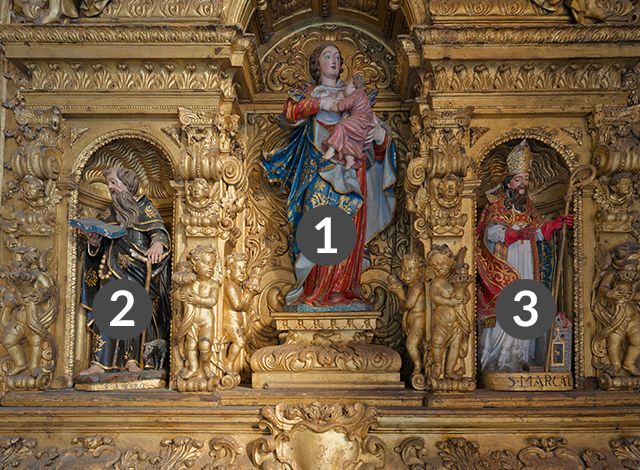
1- The Nursing Madonna, breastfeeds the Child Jesus, an image that exalts Mary's maternal role as the Mother of the Saviour and, by extension, of all believers.
2- Anthony the Great (231-356), a desert hermit, wears the habit of the Religious Order of Hospitallers of St. Anthony, a medieval institution that supports the sick and chose him as its patron. A holy healer, he is the protector of skin diseases and other ailments, including ergotism, once known as ‘St Anthony's fire’.
3- Saint Martial of Limoges (3rd century), holy healer and thaumaturge, who is credited with the power to ward off epidemics, raise the dead and protect against the scourge of fires. For this reason, he holds a burning church.
Chapel of Our Lady of Piety
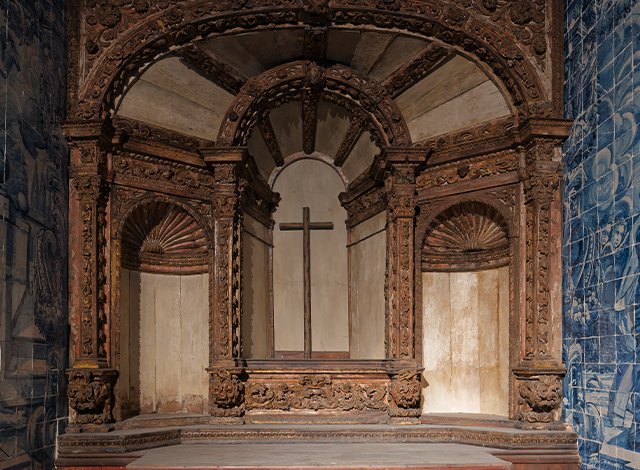
This chapel was once dedicated to Saint Catherine of Alexandria, a virgin martyr from the 3rd century and 4rd centuries, patron saint of theologians and philosophers and much venerated in the Middle and Modern Ages.
The altarpiece dates from the 17th century and the images of Our Lady of Piety, Saint Alexius and Saint Catherine, which are on display here, are being restored.